

















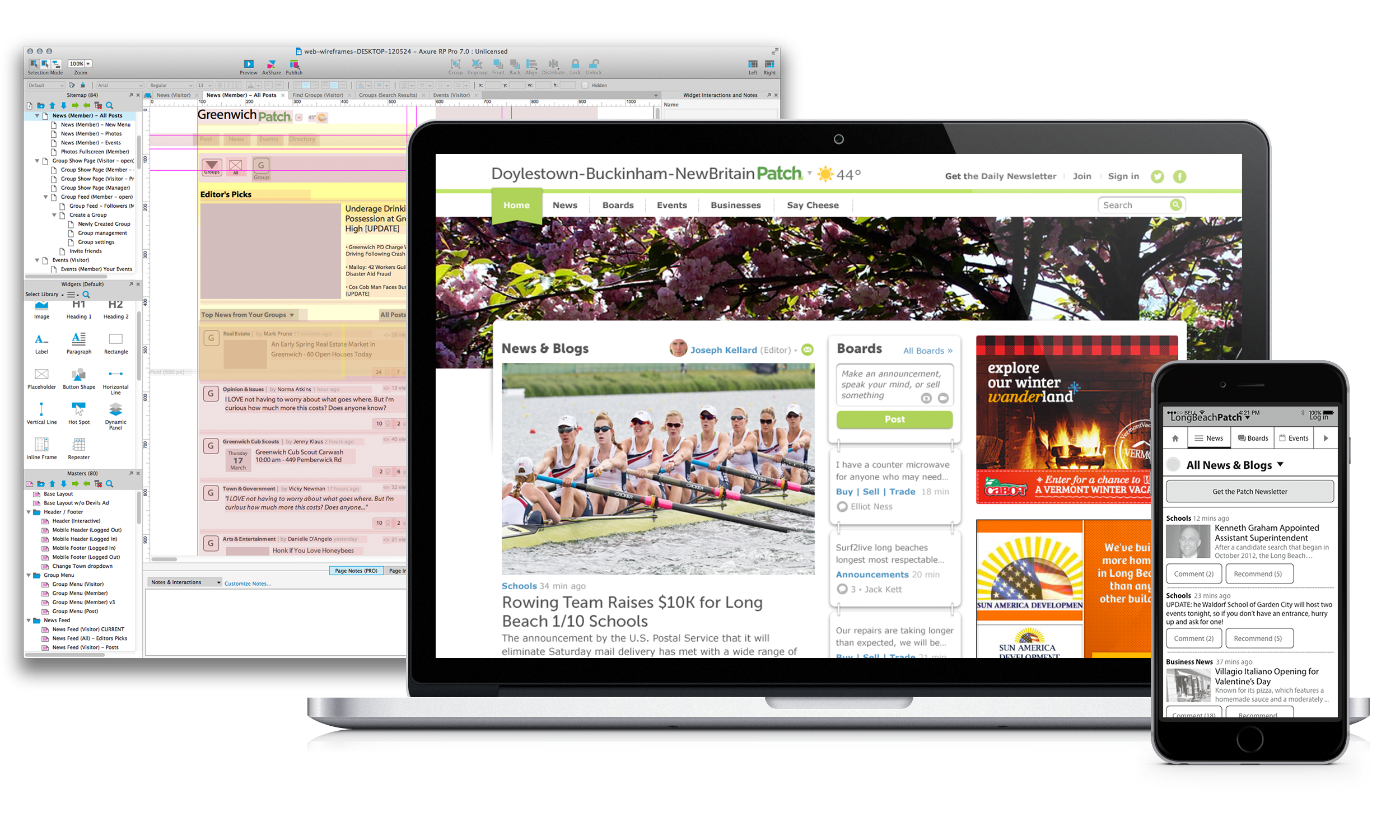
Patch.com 2.0
Redesign of Patch.com hyper-local news site, for the community, by the community
Brief
Patch was a local online newspaper with a loyal but ageing readership—engagement sat at 0.4–0.6%, younger audiences weren't connecting, and the editorial model alone wasn't enough to capture the full range of local conversation happening in these communities. The company wanted users to contribute more and community voices to surface more prominently alongside the journalism.
I was brought in to redesign Patch from a publication people read into a thriving community where people happily participated in.

The existing Patch.com
Strong loyalty, active commenting, but limited community participation.
Nationwide ethnographic research shaped a community platform hypothesis worth testing
Before designing anything, ethnographic user research was conducted across the country to understand how residents actually related to their towns and to local information.
Those findings shaped the designs of a pilot version directly—a social platform where community members could create their own groups, add their news and events, follow others, and invite neighbours, putting community organisation in the hands of residents.


A test pilot release in five Long Island towns
Rather than redesigning the full platform and deploying across all 900+ Patch towns, an test version was built as a platform of multi-use online groups where users could create their own groups, follow others, and invite people from their town.
This pilot was meant to give the team real behavioural data from actual Patch communities before any wider commitment was made. It was launched in five towns around Long Island, NY, and monitored closely through user-centred testing and iterative design updates.
Shortly after launch, a major storm hit the area, and residents turned to Patch to stay connected, coordinate, and look out for one another. The platform's community value showed up in real conditions, not a test environment.
Pilot version wireframes

Pilot homepage wireframe

Pilot group page wireframe

Pilot directory wireframe
Pilot version visual designs

Pilot homepage

Pilot group page

Pilot event page
Real learnings led to editorial news and community boards
After the pilot launch, and with multiple rounds of usability testing—both in-house and in the field—showed that the group model put too much on users. Creating a group, inviting people, managing followers was more than what Patch's audience was ready for.
The redesign split the platform into two distinct sections with clear purposes: a journalist-led side covering the structured local beats—police, fire, local news, local government—and an open community board where any resident could post in simple categories without any setup. Readers knew which side was authoritative reporting and which was their neighbours talking. Engagement reached 8%—figures rarely seen in a local online publishing product at the time—and grew even in towns that had previously been lower in activity.
Final version wireframes

Final version homepage wireframe

Final version news page wireframe

Final version boards page wireframe
Final version visual designs

Final version homepage

Final version news page

Final version boards page
Results
Two shipped versions across a nationwide rollout to 900+ Patch towns. Test pilot launch engagement reached 1-1.2%. Final version reached 6-8%—among the highest engagement figures in a local online publishing product at the time—growing even in towns that had previously been lower in activity.
900+ towns · 6-8% engagement · 2 full versions shipped on time · successful US deployment nationwide