

















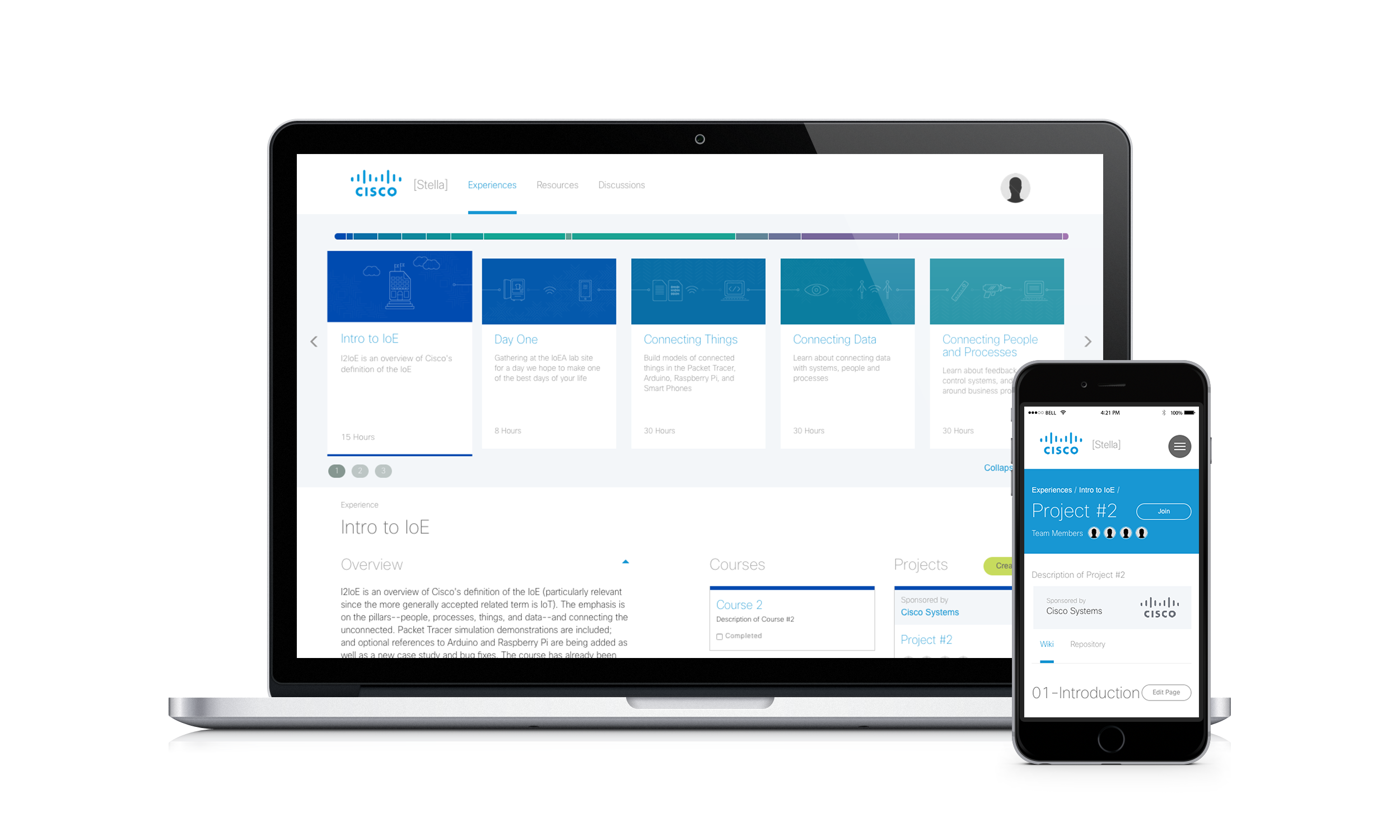
Cisco SkillZone
An online technology employment and education platform for the future of networking
Cisco Corporate Social Responsibility had an initiative—educate the next generation of Internet of Things specialists alongside strategic partners—but no platform to support it. There was no existing product, no defined user experience, and no shared understanding across the educators, technicians, project managers, and directors who all had a stake in what it should be.
I was brought in to design an online education platform for a pilot programme, from initial concept through to an MVP ready for testing.
Getting to know our audience
The platform needed to serve a very broad audience audience: high-school students in search of a viable career, veterans in search of preparing themselves to come back to the private sector, workers in search of skill change or upgrade, interested in an Information Technology career in an emerging field, with no prior experience or skills meant or why they mattered. The strategic direction was to ground every decision in that audience first.
This meant talking to real prospective students before designing anything and gathering their thoughts and contexts into profiles that would ground us to, and remind us of, real needs from real users.


Stakeholders understood the vision by experiencing it, not reviewing it
The programme involved educators, marketing, management, and technical teams, each with different priorities and no shared picture of what the platform should do. Rather than presenting requirement documents or static wireframes, I built a high-level interactive prototype that walked stakeholders through the experience as a user journey, to keep them aligned through an experience rather than a static spec.
This gave every team a concrete, navigable reference point. Feedback shifted from abstract disagreements about features to specific reactions to actual screens.


Informal hallway testing shaped the actual flows
Formal research covered prospective students. But the platform also needed to work for instructors running it day-to-day. I ran informal usability testing sessions in the hallways with instructors and students from related courses at the Cisco Networking Academy — the closest available proxy for the real audience.
These sessions fed directly back into the iterative prototype, alongside feedback gathered from education, marketing, and management in regular stakeholder meetings.


A fully coded prototype as the build target
Translating an interactive prototype into a development spec leaves room for interpretation at every step. To close that gap, I coded a fully functioning prototype in HTML5, Bootstrap, JavaScript, and a CSV database—covering the interactions, navigation, and content structure the MVP needed to support. The database was a series of Google Spreadsheets, which allowed teachers to test their educational material.
This became the design reference and specification for the development team, and the basis for interfacing with them on what was achievable within the platform's capabilities and the pilot timeline.


Results
An MVP education platform designed, prototyped, and delivered for a pilot programme aimed at preparing students for IoT careers in a billion-dollar global market opportunity. The platform covered course delivery, project collaboration, and an onboarding experience, tested against students and instructors from the Cisco Networking Academy before pilot launch.
1 fully-fledged MVP prototype · 1 pilot programme · 1 IoT workforce training and employment platform