



















Google Marketing Content Management System
Content Management System for Agencies working with Google all around the world.
2016
Google CorpEng had already built more than half of a CMS for Google departments worldwide when I was brought in. The engineering team had modelled it on Git — version control, branching, merging, conflict resolution — because that was the tooling they knew. The people who would actually use it were advertising agency teams and design studios, for whom none of those concepts applied.
I was brought in to make the product workable for that audience, drawing on user research, subject-matter expert interviews, and my own experience working in design studios and advertising agencies.
Approach
The core issue was a mismatch between the mental model baked into the existing build and the mental model of the people who would use it. Advertising and design studio users don't think in commits, branches, or merge conflicts. They think in drafts, reviews, approvals, and publishing cycles.
The direction was to reframe the entire interface around those workflows — retaining what had been built where it could be adapted, and replacing what couldn't be, grounded in user research that demonstrated the gap between how engineers and creative professionals relate to content.

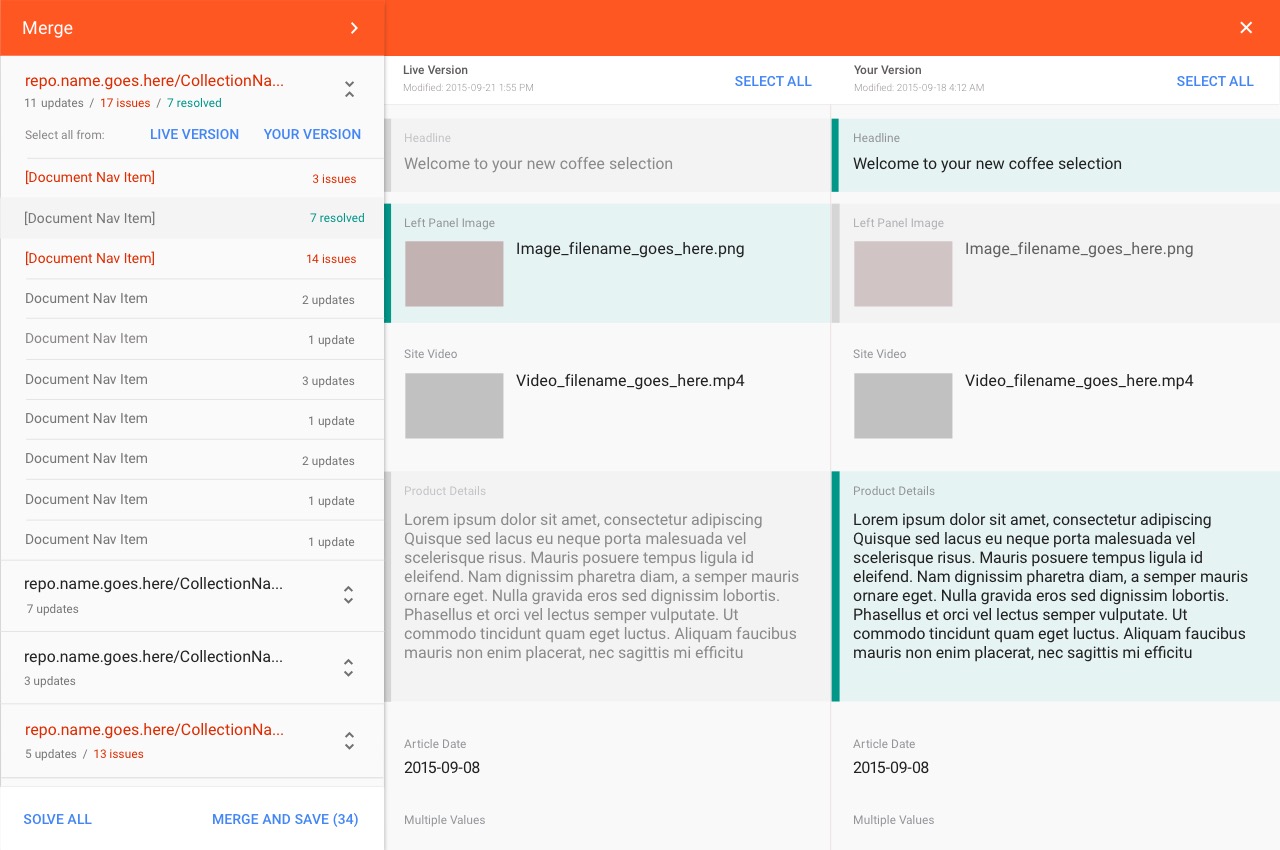
The CMS content diff view — issue counts, resolved states, and merge controls redesigned for content editors, not developers.
Content creators don't treat content like code
More than half the CMS had been built on the assumption that marketers and designers would work the way developers do — managing content through a Git-like system of schemas, versioning, and conflict resolution. User research and subject-matter expert interviews demonstrated clearly that advertising and design studio users had no mental model for any of that.
Content for them was not a codebase. It was a draft that became a final. The interface was rebuilt around that reality.


A content tool that spoke their language
The existing build treated content schemas as database schemas — the same structure, the same logic, the same language. Interviews with subject-matter experts in advertising and content management showed that the way creative teams categorise content has no natural relationship to how it is stored in a database.
The CMS was redesigned so content types were defined in terms that made sense to editors, while the database mapping was handled entirely on the engineering side.


A mid-build rescue shipped worldwide
Taking over a project where more than half the functionality had already been built in a direction that didn't serve the intended users required rebuilding within an existing technical architecture rather than starting fresh. The redesign had to work with what the engineering team had built while systematically replacing the assumptions that made it unusable for advertising and design audiences.
The result was a CMS that shipped and was adopted by Google departments globally.


Results
A worldwide CMS delivered for Google departments, built with a team of 12 Google CorpEng engineers across Sunnyvale and New York. Redesigned mid-build from a Git-modelled system into a content tool built for advertising agencies and design studios, grounded in user research and subject-matter expert interviews.
12 engineers · 50%+ rebuilt mid-project · Google departments worldwide · ad agency & design studio users served