

















Fluidtime Service Apps
Design for the Fluidtime applications for mobile phones.
2003
Turin's public transport system needed a way to give commuters real-time bus arrival information on their mobile phones — before smartphones existed. Fluidtime's Java mobile applications would show commuters when their next bus was arriving, visually and at a glance.
I designed the graphical interface for the Fluidtime mobile Java applications: a set of transit tools that turned real-time bus data into simple, visual arrival indicators on the small screens of mid-2000s phones.
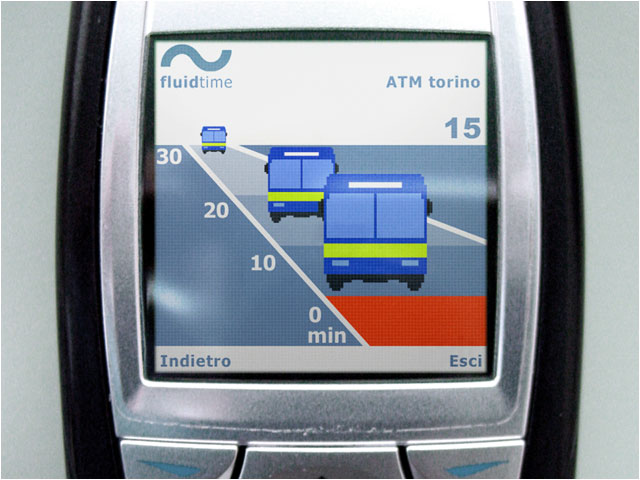
Bus arrivals visualised for a glance
The core interface showed bus arrivals as a visual timeline — buses approaching a stop along a horizontal track, with the next arrival highlighted and time-to-arrival shown in large type. A commuter could open the app and know in under a second whether they needed to hurry or could wait.
The visual language used colour and scale to communicate urgency: the nearest bus was largest and most prominent, while further-out arrivals receded. The interface also included a 'your next bus is on its way' confirmation state — a deliberate design choice to reduce the anxiety of waiting without information.


The design explored multiple visual approaches
The interface went through several visual explorations — from timeline-based arrival views to applet-style compact displays to area-based service point maps. Each approach was tested against the same question: can a commuter standing at a bus stop in Turin understand what's happening in under three seconds?
The explorations covered different contexts: individual stop views for commuters with a regular route, area maps for visitors or unfamiliar travellers, and schedule models showing the underlying data structure.


Results
GUI design for Fluidtime's Java mobile transit applications — real-time bus arrival visualisation for Turin's public transport system, designed to be understood at a glance on small-screen mobile phones.
13 screens · Java mobile apps · real-time bus arrivals · visual timeline interface · designed for Fluidtime / ATM Torino